
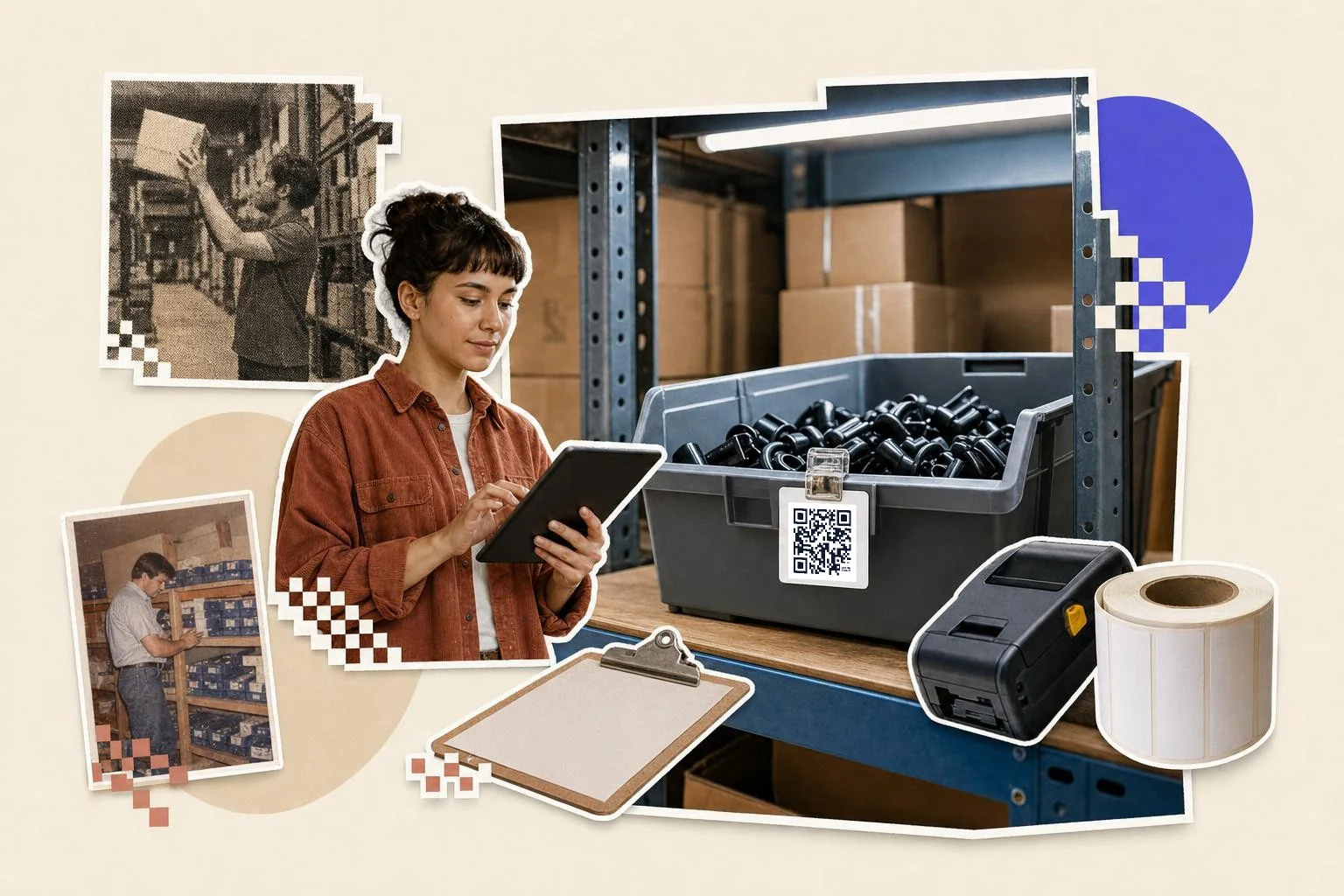
You do not need asset software to start
The honest shape of this is a spreadsheet with one row per asset and a QR code on each one that opens that row. That is it. Google Sheets, Excel on OneDrive, Airtable, Notion: anything that gives a row or a page its own web address will work.
We make the codes. We are not an inventory system and we do not hold your stock levels, so nothing here asks you to move your data. If you outgrow a spreadsheet you will want real asset software, and the labels you printed can be re-pointed at it rather than reprinted, which is the one thing a static code cannot survive.
- A row per item in a sheet: cheapest, works today, fine up to a few hundred items.
- A page per item in Notion or Airtable: better when each item needs photos or a history.
- A PDF manual on your own site: right for machines, tools and anything with a service interval.
- A folder of photos: right for condition records, damage and handover.
What the scan count gives you that a barcode never did
A barcode is a number. Nothing happens when nobody scans it, and nothing is recorded when somebody does. A dynamic QR code is a redirect, so every scan leaves a timestamp, and that turns the label into a lightweight record of attention.
In practice that answers questions people usually guess at. When did anyone last look at this fire extinguisher, this returned pallet, this tool in the back of the van? Which of the forty items nobody has touched in a year? It is not an audit system and we would not sell it as one, but it is a date against an object, for free, with no process for anyone to follow.
Printing labels that survive the place they live
An inventory label has a harder life than a menu. It gets handled, rubbed, frozen, washed down, and left in sunlight, and the code has to still read in five years when somebody needs the manual.
Print black on white, with no logo in the middle, and leave the quiet zone. Then choose the material for where it lives: paper for a dry shelf, polyester or vinyl for anything handled, and a laminate over the top for cold stores or anywhere it gets wet. On curved surfaces, go a size up and keep the code on the flattest face you can find.
- Flat and dry: plain label paper is fine and costs nothing.
- Handled daily: polyester or vinyl, or a laminate over paper.
- Outdoors or cold: laminated vinyl, and check it after one winter.
- Curved: one size up, on the flattest part, never across a seam.
How big to print it
Rule of thumb: the code should be at least one tenth of the distance it is scanned from. These are the sizes that work in practice for this job.
| Where | Scan distance | Minimum width |
|---|---|---|
| Tool or cable tag | 4-8 in (10-20 cm) | 0.6 in (1.5 cm) |
| Box or bin label on a shelf | 1-2 ft (30-60 cm) | 1 in (2.5 cm) |
| Equipment plate on a machine | 2-3 ft (60-90 cm) | 1.5 in (4 cm) |
| Pallet or rack label | 6-10 ft (2-3 m) | 4 in (10 cm) |
Why make it dynamic
Labels outlive the things they point at. You move the spreadsheet to a new folder, rename the file, switch from Sheets to something else, or the item itself moves to another site, and every static label you stuck on every shelf is now wrong. A dynamic code points at a short link we redirect, so you change the destination once and the labels already on the boxes keep working. That is the whole reason this job needs editable codes more than any other on this site.
Dynamic codes are part of Premium, $4 a month. Static vs dynamic, explained.
Step by step
- 1
Give each item a web address
A row in a sheet, a page in Notion, a PDF on your site. Anything a phone can open. Copy that address for the first item.
- 2
Make the code dynamic
Paste the address below and save it to a free account. Your first dynamic code is free, and dynamic is what lets you re-point the label later when the sheet moves.
- 3
Name it so you can find it again
Call it what the item is called, not Code 1. In six months the list of codes is the only index you have.
- 4
Download the SVG and print the labels
SVG stays sharp at any size, which matters when the same artwork goes on a tiny tool tag and a pallet label.
- 5
Test the printed label, not the screen
Scan the real sticker on the real surface, in the light that room actually has. A code that reads on a monitor can fail on satin label stock under a warehouse lamp.
- 6
Do the rest in bulk
On Business you can make codes for a whole list at once through the API or a CSV, rather than one at a time.
Questions people ask
- Is there a free way to track inventory with QR codes?
- Yes. A spreadsheet you already have, plus a code per item pointing at its row, costs nothing. Generating the codes here is free, and your first dynamic code is free too. You only pay when you want every code to be re-pointable or you need the scan history.
- How do I create a QR code for tracking an item?
- Copy the web address of the thing that describes that item, paste it into the generator on this page, save it and download the SVG. The code opens that address when anyone scans the label. Make it dynamic if the address might ever change.
- Do QR codes replace barcodes for inventory?
- Not usually, and they do not have to. A barcode identifies the product at a till and a scanner gun reads it faster. A QR code opens something for a person holding a phone. Most small operations end up with barcodes on what they sell and QR codes on what they own.
- What happens when an item moves or is sold?
- With a dynamic code you re-point the label at the new row, or at a page saying the item was disposed of, and the sticker stays where it is. With a static code the label is wrong forever and has to be replaced.
- Can I make hundreds of codes at once?
- Yes, on Business, through the API or a CSV upload. For a few dozen, making them one at a time on this page is quicker than setting up the bulk route.
Make the code now, change the link later
Free to make and print. Premium ($4/mo) keeps it editable and counts every scan.