
The one question that settles it
Ask who is holding the scanner. If the answer is a line camera, a handheld industrial reader or a verification station, Data Matrix is the safer bet and usually the required one. If the answer is a customer, a nurse, a technician on their own phone or anyone who did not come prepared, use a QR code.
Apple documents the iPhone Camera app and Control Center for scanning QR codes, and does not document Data Matrix. Google's own ML Kit does read Data Matrix on Android, but with a catch its documentation spells out: the code has to intersect the center of the image, and only one can be read at a time. So the honest position is that a Data Matrix needs the right app or the right reader, while a QR code works on whatever phone walks up.
What each one actually holds
A Data Matrix using the ECC 200 standard tops out at 2,335 alphanumeric characters or 3,116 digits in its largest square, 144 by 144 modules. Its error correction is not a setting you choose; it is fixed by the symbol size and lands between roughly 14% and 27%. The rectangular versions are much smaller, around 72 alphanumeric characters, and exist to fit a narrow strip.
A QR code goes further, to 4,296 alphanumeric characters or 7,089 digits at its largest size and lowest error correction, and lets you choose the error correction level from about 7% up to about 30%. That choice is why a QR code can survive a logo in the middle or a scratch across a label.
In practice neither limit matters, because a sensible code holds a short link, not a document. What matters is the next section.
- Data Matrix, largest square: 2,335 alphanumeric or 3,116 numeric.
- QR code, largest size: 4,296 alphanumeric or 7,089 numeric.
- Data Matrix error correction: fixed by size, roughly 14% to 27%.
- QR code error correction: chosen, roughly 7%, 15%, 25% or 30%.
- Data Matrix quiet zone: 1 module on each side.
- QR code quiet zone: 4 modules on each side.
Why Data Matrix wins on small parts
Two things make a Data Matrix smaller than a QR code carrying the same data. It needs a quiet zone of only one module on each side, where a QR code needs four, and its finder pattern is an L-shaped solid edge rather than three large squares in the corners. On a mark a few millimeters across, those corner squares and that four-module margin are most of the space.
That is why Data Matrix is the standard where the part is the problem: surgical instruments, circuit boards, aerospace components under MIL-STD-130, medical device unique identifiers, and pharmaceutical packs. If you are laser marking something you could lose in your hand, Data Matrix is almost certainly the answer, and the standard covering your industry has probably already decided for you.
Why QR wins everywhere a person is involved
A QR code is the only 2D code the general public can scan without being told how. No app, no instructions, no reader. That single fact outweighs every capacity and size advantage the moment a human being is the one scanning.
It also means a QR code can do a second job a Data Matrix usually cannot: take someone somewhere. A marked part can carry its serial number for a machine to read, and a QR code can carry a link that opens the manual, the service history, the reorder page or the recall notice for that exact item.
Retail is moving the same way. GS1's Sunrise 2027 is a date retailers have set for themselves, not a mandate, and it points at the 2D code on packaging being a QR code carrying a GS1 Digital Link, so one square can serve a checkout scanner and a shopper's phone. Data Matrix is not what that plan is built around.
What we can and cannot make here
QRFLOW.codes generates QR codes. It does not generate Data Matrix codes, and this page is not going to pretend otherwise. If a standard in your industry requires a Data Matrix, you need marking software or a reader vendor built for direct part marking, not a code generator.
What we are good for is the other half of the job. If the thing being marked also needs something a person can scan, make that QR code here, point it wherever it needs to go, and change the destination later without touching the part. Printing a QR code on metal covers contrast, finish and the sizes that survive engraving.
Using both on the same item
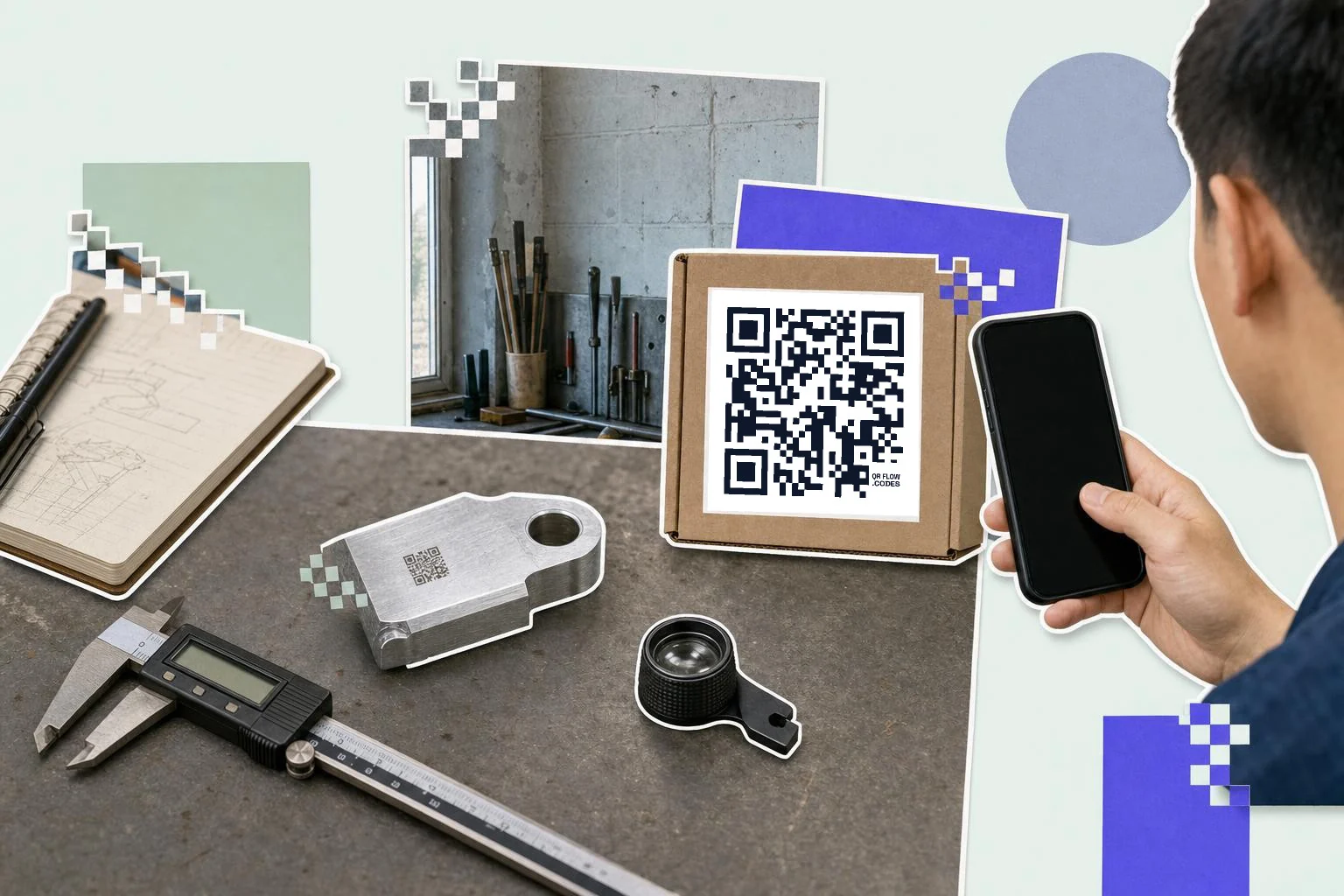
Plenty of products carry both, and that is not a failure to decide. The Data Matrix is marked small on the part itself and holds the identifier a machine reads on a line. The QR code goes on the label, the carton or the plate, large enough for a phone, and opens whatever the person holding it needs.
If you do this, keep them doing different jobs. Two codes next to each other that go to the same place teach people to ignore both, and a scanner that finds the wrong one first is a support call.
How big to print it
Rule of thumb: the code should be at least one tenth of the distance it is scanned from. These are the sizes that work in practice for this job.
| Where | Scan distance | Minimum width |
|---|---|---|
| Part or instrument, machine read | Fixed reader | Set by your marking standard |
| Carton or label, phone scanned | 6-12 in (15-30 cm) | 1 in (2.5 cm) |
| Equipment plate, phone scanned | 1-2 ft (30-60 cm) | 1.5 in (4 cm) |
Why make it dynamic
A marked part outlives the system it was marked for. The machine gets a new maintenance portal, the product page moves, the manual is replaced. A static Data Matrix carries its data in the mark itself, so changing anything means re-marking every part. A dynamic QR code carries a short link instead, and the destination behind it moves whenever you need it to, while the mark stays exactly as it was stamped.
Dynamic codes are part of Premium, $4 a month. Static vs dynamic, explained.
Step by step
- 1
Decide who scans it
A machine or a trained reader points to Data Matrix. A person with a phone points to QR.
- 2
Check your industry's standard
Medical, aerospace and pharma often mandate Data Matrix. That decision is already made for you.
- 3
Make the QR half here
Paste the link the person should land on, and keep it dark on a light background.
- 4
Test on the real surface
Scan the actual marked or printed item with two phones before committing a production run.
Questions people ask
- Is a Data Matrix better than a QR code?
- Neither is better; they answer different questions. A Data Matrix fits more data into a smaller mark, which wins on tiny parts. A QR code is the one an ordinary phone reads without an app, which wins anywhere a person is scanning.
- Can my phone scan a Data Matrix code?
- Not reliably with the built-in camera. Apple documents its Camera app for QR codes and not for Data Matrix, so an iPhone user generally needs a separate app. Android can read Data Matrix through apps built on Google's ML Kit, but it is not something you can assume of a stranger's phone.
- Why is a Data Matrix smaller than a QR code?
- Two reasons. It needs a quiet margin of one module on each side where a QR code needs four, and its finder pattern is an L-shaped edge rather than three large corner squares. On a mark a few millimeters across, that difference is most of the space.
- Which one holds more data?
- A QR code. It reaches 4,296 alphanumeric characters or 7,089 digits at its largest size, against 2,335 alphanumeric or 3,116 digits for the largest square Data Matrix. In real use both are far more than a short link needs.
- Does QRFLOW.codes make Data Matrix codes?
- No. QRFLOW.codes makes QR codes only. If a standard in your industry requires a Data Matrix, you need direct part marking software rather than a code generator.
- Is GS1 moving to QR or Data Matrix?
- For retail packaging, QR carrying a GS1 Digital Link is what Sunrise 2027 points at, so one square can serve both a checkout scanner and a shopper's phone. GS1 DataMatrix remains in use in healthcare and other settings where the mark has to be small.
Make the code now, change the link later
Free to make and print. Premium ($4/mo) keeps it editable and counts every scan.