VS Code with Copilot alone vs VS Code with Copilot with QRFLOW
Copilot can write a script that renders a static QR PNG with a library. Not editable after printing, not tracked.
| VS Code with Copilot alone | VS Code with Copilot + QRFLOW | |
|---|---|---|
| The code you get | A static PNG with your link inside | A dynamic code in your QRFLOW account (static on Free) |
| Change where it goes after printing | No | Yes, in one sentence |
| Count scans, by day, country, device | No | Yes |
| Your own domain in the code | No | Yes, on Premium and Business |
| Wi-Fi, review, Instagram, PDF and 40 more kinds | Only if you write the format yourself | Ask for the kind by name |
| Pause, expire, rename, bulk | No | Yes |
| Where it lives afterwards | In the chat | On your dashboard, tagged with the assistant's name |
Once, about a minute
Install the connector
Add it by pasting the address
- 1
Run MCP: Add Server
Open the Command Palette (⇧⌘P or Ctrl+Shift+P), run "MCP: Add Server", choose HTTP, paste the address and name it qrflow. Pick Workspace to share it with the repo (.vscode/mcp.json) or User for every project.
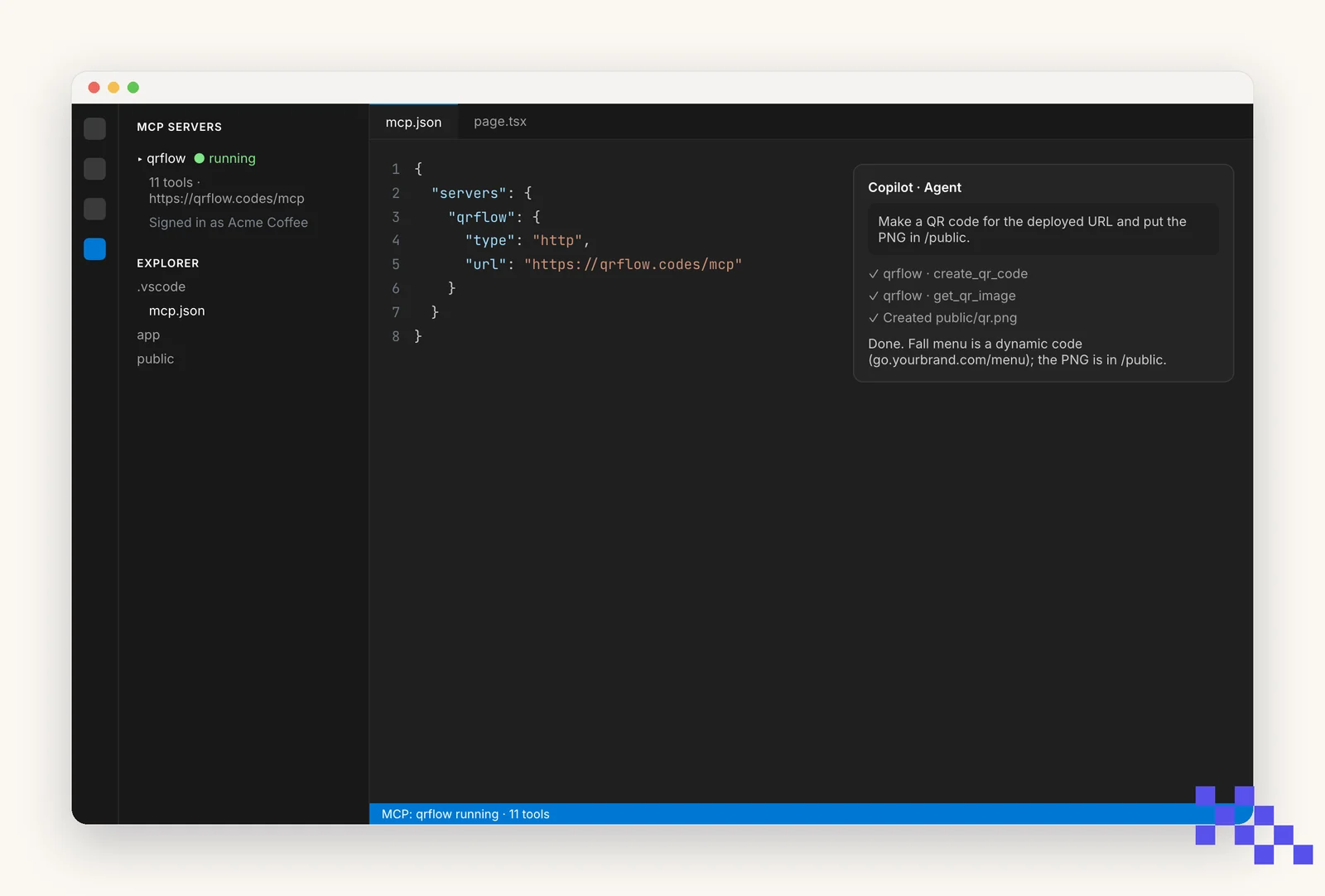
- 2
Sign in
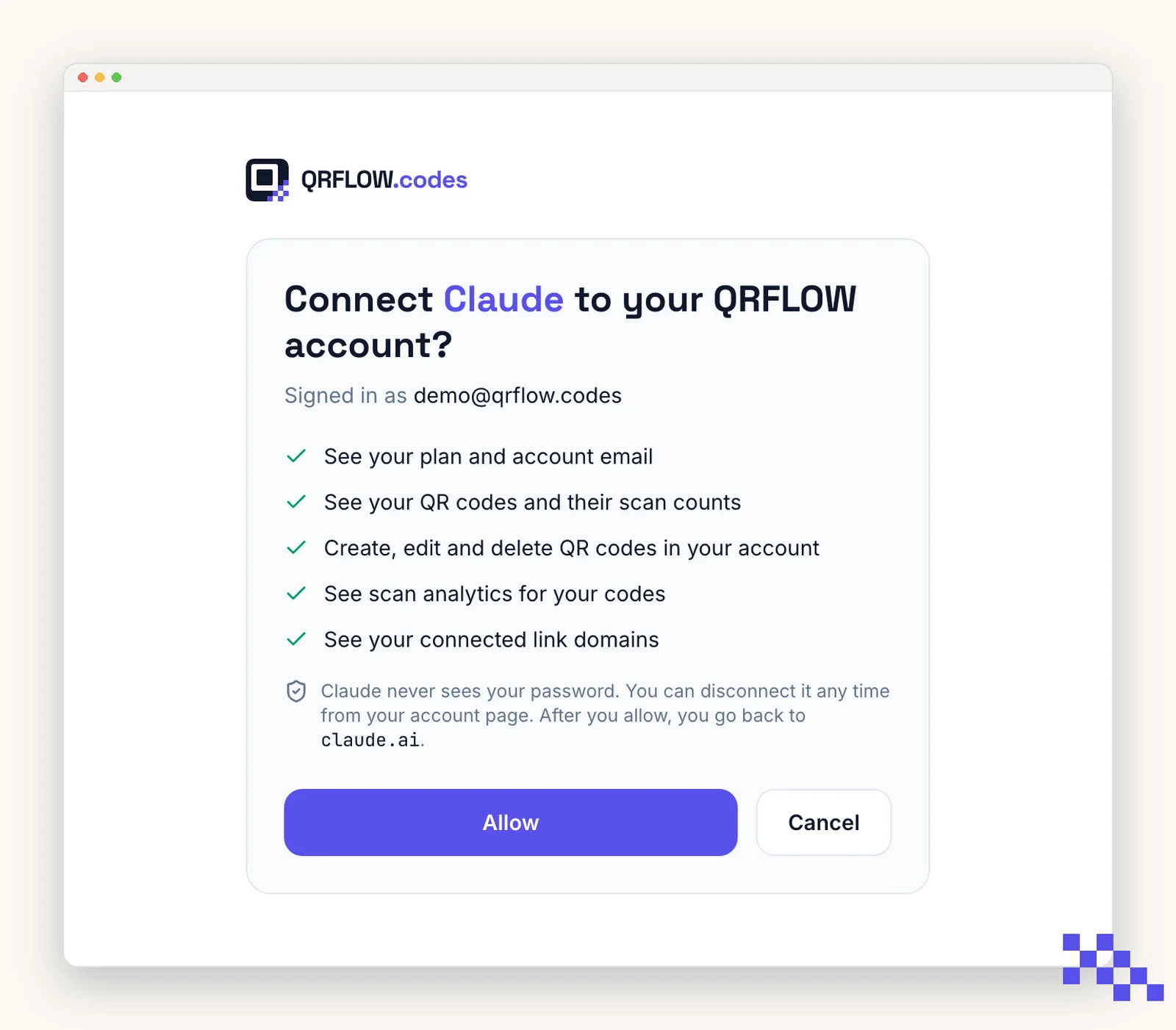
Start the server from the MCP Servers view (or when the agent first needs it). VS Code opens a QRFLOW page in your browser: sign in and press Allow.
Then
- 1
Ask in agent mode
Open Copilot Chat, switch to Agent, and ask: "make a QR code for the deployed URL and put the PNG in /public". VS Code shows the tool call and asks before anything that changes your account.
The app screens above are simplified drawings, not screenshots; labels follow each app's own and can move between versions. The QRFLOW consent screen is the real one.
https://qrflow.codes/mcp
{
  "servers": {
    "qrflow": { "type": "http", "url": "https://qrflow.codes/mcp" }
  }
}
The agent decides when to call QRFLOW. Say what you want; approve the tool call when VS Code asks.
Copy and paste
Say this
“Make a QR code for our app page and save the SVG into /public/qr.svg.”
“List my QR codes and tell me which have zero scans.”
“Point the App download code at the new App Store link.”
“Make a QR code for each URL in links.txt, named after the line.”
Any kind works by name. Popular ones: Link.
What it cannot do
- Add a logo to a code. Logos are added in the QRFLOW dashboard; the assistant's image then includes it.
- Make a dynamic code on the Free plan. Free makes static codes (the content is inside the picture); Premium makes dynamic ones you can change later.
- See anything outside your QRFLOW account, or act without you: you press Allow once, and deleting a code asks first.
- Move money. A Venmo or PayPal code only opens a link you gave it.
Plans
| What the assistant can do for you | Free | Premium | Business |
|---|---|---|---|
| Static codes (Wi-Fi, contact card, one-off links) | Yes | Yes | Yes |
| Dynamic codes: change the destination after printing | No | Yes | Yes |
| Scan analytics by day, country, device | No | Yes | Yes |
| Your own link domain (go.yourbrand.com) | No | 1 | 5, chosen per code |
| Bulk: many codes in one ask | No | 500/month | 10,000/month |
| Team | 1 | 1 | 5 people |
| Price | $0 | $4/month | $29/month |
The connector is free. Dynamic codes, analytics and your domain are Premium.
Questions
Can VS Code make a QR code for free?
Yes. VS Code alone can draw a static QR code, and with the QRFLOW connector the Free plan makes static codes too. A code you can change after printing, name on your domain and track needs QRFLOW Premium ($4 a month).
Is the code safe to print?
Yes. QRFLOW only accepts web, mail, phone, SMS, map and a few app links; a javascript: or data: link is refused. The picture is the same standard QR any phone camera reads.
Can it change a code that is already printed?
If the code is dynamic (Premium or Business), yes: say where it should go now and the printed code follows. A static code cannot change; ask for a new one.
What does the assistant see in my account?
Your codes, their scan numbers and your link domains, and only after you press Allow on a QRFLOW page. It never sees your password. Disconnect any time from Account › Connected apps on qrflow.codes.
Does it work on my phone?
Once connected, yes: connectors follow your VS Code account, so the same QRFLOW connection works in the mobile app.
How do I tell which codes an assistant made?
Every code shows its maker on the dashboard: a small "VS Code" badge next to the type, the way Canva codes show "Canva".
Can I use an API key instead of signing in?
Yes on Business: add "headers": { "Authorization": "Bearer qrf_live_…" } to the server entry and skip the browser. Keep the key out of a shared mcp.json; use an input variable or a user-level file.
Does this work with other VS Code AI extensions?
Any extension that reads the same MCP configuration can use the server; Copilot's agent mode is the one VS Code documents.
Next
- Make a QR code in ClaudeWorks today
claude.ai, Claude Desktop and the Claude mobile apps. In the directory: press Connect.
- Make a QR code in ChatGPTWorks today
chatgpt.com and the ChatGPT desktop and mobile apps.
- Make a QR code from Claude CodeWorks today
the terminal, VS Code and JetBrains through the Claude Code extension.
- Make a QR code from CursorBeing verified
the Cursor editor on macOS, Windows and Linux.
- Make a QR code from WindsurfBeing verified
The Windsurf editor on macOS, Windows and Linux.
- Make a QR code from CodexBeing verified
The terminal, and the Codex IDE extensions that share its config.
- Make a QR code from Gemini CLIBeing verified
The terminal.
- Make a QR code in GeminiNot yet
The Gemini app at gemini.google.com and the Gemini mobile apps.
- Make a QR code in Microsoft CopilotNot yet
The Copilot app, copilot.microsoft.com and Copilot in Windows and Microsoft 365.
- Make a QR code in PerplexityNot yet
perplexity.ai, the Perplexity desktop and mobile apps, and the Comet browser.
- Make a QR code in GrokNot yet
grok.com, the Grok apps and Grok inside X.
All assistants: Make QR codes with your AI assistant. Building it into your own app? Developer docs.